

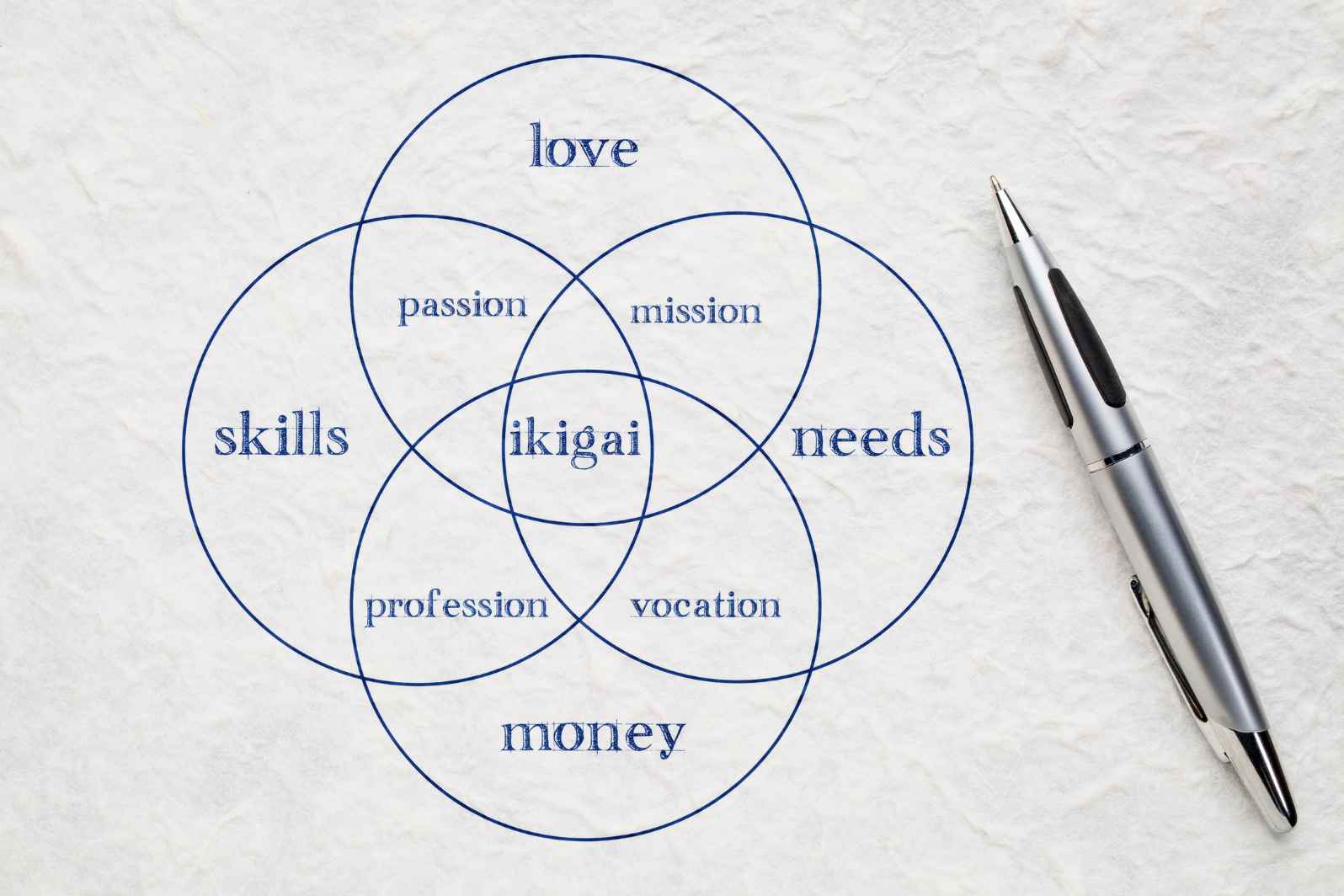
In Japan, there’s a beautiful philosophy that blends passion, mission, vocation, and profession into one. It’s called Ikigai. The word means “a reason for being,” and it reflects the idea that happiness and fulfillment come from living with purpose and balance. Ikigai isn’t about chasing success or wealth; it’s about discovering what gives life meaning every day. From small joys to lifelong goals, understanding Ikigai can help you live with intention, stay motivated, and find deeper satisfaction in both work and life.
1. What Is Ikigai?
A Japanese concept, ikigai is the cross section of what you love, what you are good at, what the world needs and what you can be paid for. It promotes a life well-lived which is both thoughtful & practical.
For example: A teacher with a passion for sharing knowledge, good at speaking and earning money by teaching.Now she found her Ikigai.
The takeaway: Ikigai is not a single, monolithic purpose; it’s a series of harmonious interests that should underpin every activity you do.
2. The Four Pillars of Ikigai
Its formula is built on four interconnected elements: passion (what you love), mission (what the world needs), vocation (what you can be paid for) and profession (what you’re good at). When the two intersect, life feels meaningful and rewarding.
The lesson: Balancing personal happiness with contribution toward society can lead to lasting joy.
3. The Cultural Roots of Ikigai
In Japan, Ikigai is strongly correlated with community and longevity. Those living in Okinawa, Japan, known as some of the longest-lived people on the planet, often attribute their Ikigai to a life that has meaning.
Example: Many older Okinawans still garden, cook or serve as community volunteers because they feel that they have a reason to get out of bed in the morning and that they belong to something larger than themselves.
The takeaway: Having a sense of purpose can lead to both better physical and mental health.
4. The Contrast Between Ikigai and Success in the West
In Western Culture success often is measured by wealth or status versus Ikigai which values daily contentment and balance. It is more concerned with meaning than it is with commodities.
Example: Instead of pursuing the next promotion, someone might discover pleasure in mentoring others or building something worthwhile.
The upshot: Purpose, not possessions, brings true fulfillment.
5. Discovering What You Love
Step 1: Find what makes you alive The key to finding your Ikigai, is to know the answer of following; What brings you joy, and makes you feel alive – Things that recharge your batteries, things that excite or inspire you.
By writing or cooking or painting, or serving others.’ ”Example: Writing, cooking, painting, helping … could be that spark that constitutes your own personal joy.
Takeaway: Passion is the lively heart that keeps your Ikigai going, and it is very helpful sign to identify your life’s purpose.
6. Recognizing What You’re Good At
We all have something to offer others. Knowing what you’re good at enables you to use them in a way that has meaning.
Example: For a person who is analytical and has good problem-solving ability, Ikigai may be found in engineering; for the artistic and imaginative individual, it may appear in design.
The lesson: Your talents can lead you to rewarding work.
7. Serving What the World Needs
Ikigai also means serving something bigger than yourself. Whether by helping people, protecting the environment or inspiring others, purpose is power in relational service.
Example: A doctor or an artist or a teacher all provide value by making the lives of other people better in diverse ways.
The lesson: Purpose becomes stronger when it has a positive effect on others.
8. Honing What You Can Get Paid For
Financial stability ensures that your Ikigai sustains you. The trick is to figure out how to monetize what you love without sullying its meaning.
Example: A health nut might teach yoga or personal training to marry passion and livelihood.
The takeaway: Ikigai is the constant pursuit of finding what you love versus what people are willing to pay for.
9. Contribution of Mindfulness and Gratitude
Ikigai means mindfulness, the ability to live in the moment. Jolts of appreciation for that cup of tea, that phone call! – nurture your sense of purpose.
Example: Journalling or daily reflection is a way to reconnect with what’s more important.
The lesson here: Gratitude turns common days into sources of meaning.
10. Overcoming Obstacles to Finding Ikigai
Many of us are in search of purpose because we’re blinded by the allure of instant answers. Ikigai is wisdom and comes with patience and self-awareness.
For example: Trying different hobbies, volunteering or changing careers can slowly help you understand where your true interest lies.
Takeaway: Finding your Ikigai is a process of ongoing growth and reflection.
11. Living with Purpose Every Day
Ikigai isn’t only about exalted goals; it’s about finding meaning in daily routines. Everything from making breakfast to staying in touch with loved ones can be imbued with your intention.
For example – a gardener watering their plants every morning or a parent reading with their child – these are Ikigai in motion.
The lesson: Purpose is not something you find one day of your life; it’s how you live each and every day of your conscious actions.
Conclusion
Japanese Ikigai expos the truth that a meaningful life is not about endless pursuit, but it’s to find purpose, balance and gratitude. When what you love to do, what you’re good at, what the world needs and what the world is willing to pay for come together, well-being becomes a way of life. In adopting Ikigai you can face each day not just with clarity and joy, but also with a clear sense of direction knowing that your life is both meaningful and harmonious.
FAQs:
Q1. What is the meaning of Ikigai?
It is the “reason for being” or the “why” that makes life worth living.
Q2. Can anyone find their Ikigai?
Indeed, with reflection and some patience, that is true for anyone.
Q3. What do you stay passion over Ikigai for?
Passion is only one aspect of Ikigai; real Ikigai lies at the intersection of passion, skill, mission and vocation.
Q4. Does Ikigai guarantee happiness?
It’s about achieving balance and fulfillment, so you experience joy in both the little things and the big ones.
Q5. I want to start living my Ikigai NOW?
Figure out what your passions are and what you’re good at that can better the world and earn some money along the way.
